How to Search Hours of CCTV Footage Using AI
1. The Real Pain of Reviewing CCTV Footage
Every security professional knows the frustration: an incident occurs, and someone must go through hours — sometimes days — of CCTV footage to find what happened.
The traditional process involves scrubbing timelines manually, switching between camera angles, rewinding, pausing, and replaying the same sequences multiple times. It’s slow, mentally draining, and highly error-prone.
That reality creates a predictable set of operational problems:
- Massive time consumption for basic investigations
- Human fatigue, which increases the chance of missed details
- Delayed response times to incidents
- High operational cost in labor hours
As surveillance coverage expands, so does the volume of stored video. Modern facilities generate huge archives that teams simply cannot review manually at scale.
2. CCTV Video Is Growing Faster Than Teams Can Analyze
Cameras are cheaper, storage is larger, and retention periods are longer. Most sites now operate with:
- Multiple camera angles per location
- Higher resolution footage (HD / 4K)
- Continuous recording 24/7
- Weeks or months of footage retention
The result is obvious: CCTV is no longer “just video.” It is a growing dataset. But without structure, it remains extremely difficult to review, search, and report on.
3. The Key Shift: From Playback to Structured Video Intelligence
Traditional CCTV tools are designed for playback. They let you scroll time and view camera feeds — but they do not transform video into structured intelligence.
What teams need today is not “faster playback.” They need CCTV footage to behave like structured data, so they can:
- See what objects appear throughout the footage
- Count how often each object appears
- Filter results instantly by detected items
- Jump to relevant timestamps without scrubbing
- Export structured evidence for reporting
That is exactly what AI-based video indexing enables.
(If you want the technical foundation behind this approach, see our authority page: AI Video Analysis.)
4. How VideoSenseAI Works (The Correct Model)
VideoSenseAI does not work by asking a question like “find a person in a red jacket” and hoping the model returns a match.
Instead, it analyzes the entire CCTV video end-to-end and builds an indexed layer of structured data:
- Extracts frames across the full duration
- Detects objects in every analyzed frame
- Indexes each detected object with precise timestamps
- Aggregates counts per object (frequency)
- Generates analytics visuals automatically (bar charts, word clouds)
- Produces structured tables (frame + timestamp + detected item)
This turns CCTV footage into a searchable dataset — not just a playback file.
To understand this concept from a “searchability” standpoint, see: Search Inside Videos.
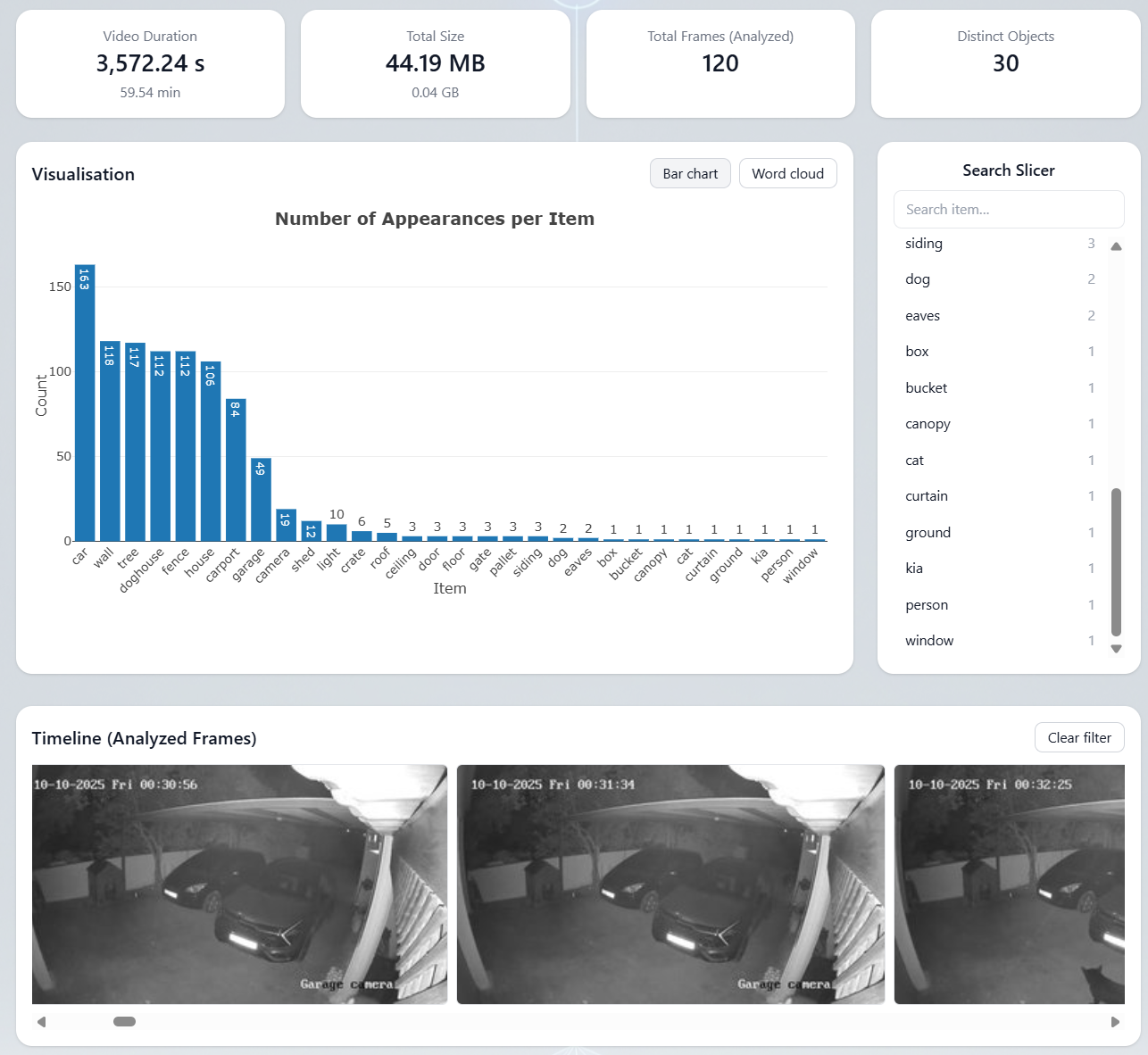
5. What You Get After Analysis (Outputs That Matter)
Once VideoSenseAI finishes processing, you don’t just see a video player. You see a full intelligence dashboard built on top of your footage.
Below is a clear breakdown of the outputs and why they matter:
| Output | What It Shows | Why It Adds Value |
|---|---|---|
| Object Aggregation | Total appearances per detected item | Instantly identifies what dominates the footage |
| Bar Chart / Word Cloud | Visual ranking of detected objects | Quick situational overview without manual scanning |
| Searchable Item List | Filter by detected objects | Jump to what matters in seconds |
| Structured Table | Frame + timestamp + item | Creates defensible evidence trails and reporting |
| Timeline of Frames | Visual navigation across analyzed frames | Review key moments fast without scrubbing |
| AI Summary | High-level description of footage | Instant context for investigators and stakeholders |
| Transcription + Word Counts | Searchable transcript and frequency analytics | Useful for audio-enabled cameras and incident narration |
| Exports (CSV/JSON/TXT) | Downloadable structured datasets | Supports audits, compliance, and reporting workflows |
This is why VideoSenseAI behaves like a true Video Search Engine — not because it guesses results, but because it indexes and structures the full video first.
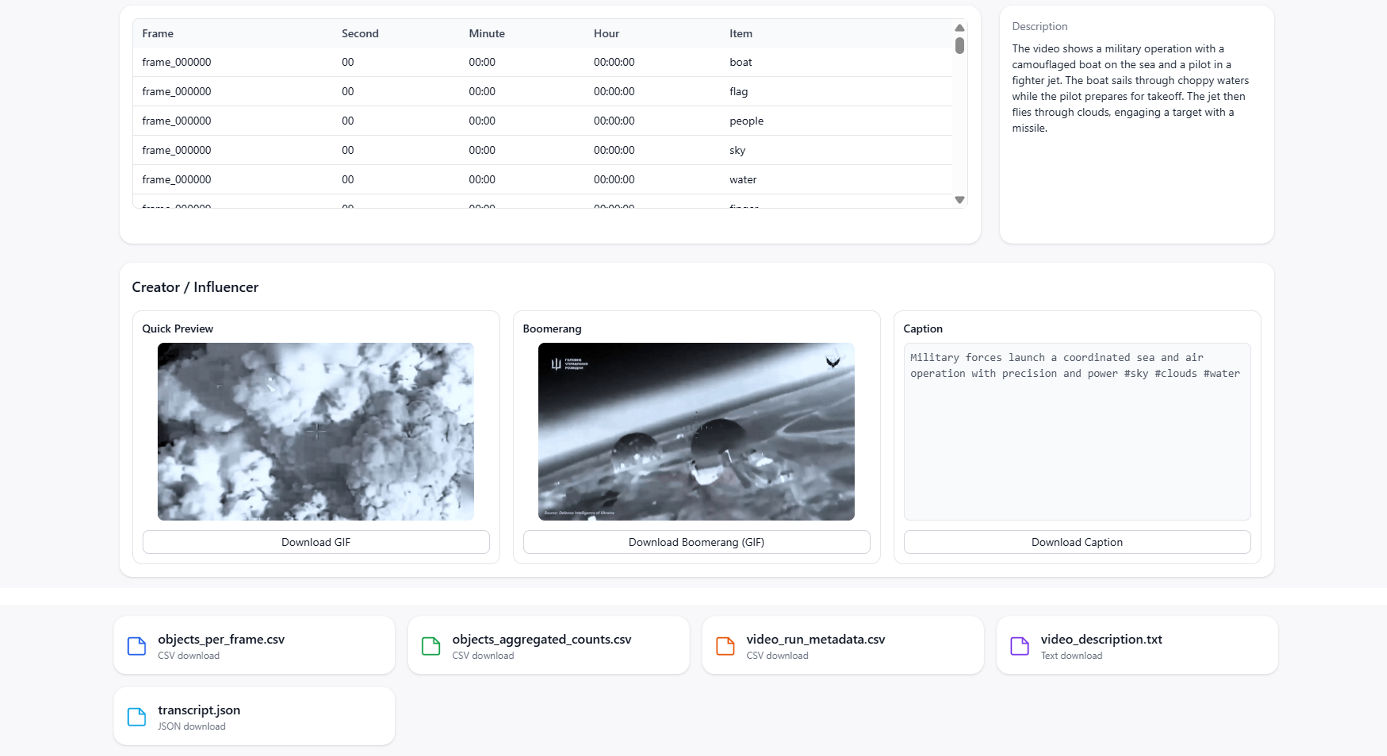
6. Ease of Use: Upload, Analyze, Filter, Export
VideoSenseAI is designed to be simple and self-serve. There is no complex setup, no on-premise installation, and no enterprise onboarding just to get value.
A typical workflow looks like this:
- Upload your CCTV clip or footage segment
- Analyze — the system processes frames and indexes detected objects
- Explore results via visuals (bar charts / word clouds) and searchable item lists
- Filter by object to focus on what matters
- Review the timeline and structured table with timestamps
- Export structured evidence files (CSV/JSON/TXT)
Instead of spending hours manually reviewing footage, teams can move straight to analysis and evidence building.
7. Why VideoSenseAI Is Faster, Cheaper, and More Practical Than Alternatives
Many “competitive” CCTV AI systems fall into two extremes:
- Basic tools that only provide playback and storage
- Enterprise systems that require contracts, integrations, and heavy deployments
VideoSenseAI sits in the middle: enterprise-grade structured indexing, delivered with a simple web workflow.
| Category | Manual Review | Enterprise CCTV AI | VideoSenseAI |
|---|---|---|---|
| Time-to-Insight | Hours / Days | Fast (after setup) | Fast (self-serve) |
| Structured Object Indexing | No | Yes | Yes |
| Analytics (Charts + Tables) | No | Sometimes | Yes |
| Setup & Integration | None | High | None |
| Cost Profile | High labor cost | High contract cost | Subscription-based |
For most organizations, the practical win is clear: structured indexing and analytics without enterprise friction.
8. How Structured CCTV Intelligence Adds Business Value
By converting CCTV footage into structured data, VideoSenseAI enables:
- Faster incident investigations and shorter response time
- Better evidence documentation through timestamped item tables
- Improved reporting using analytics visuals (counts, distributions)
- Reduced operational workload for security personnel
- Exportable datasets that support audits and compliance workflows
In short: your CCTV becomes a searchable intelligence asset — not just a passive archive.
9. Conclusion: Stop Watching Footage — Start Analyzing It
As video data continues to grow, manual review becomes increasingly inefficient.
VideoSenseAI transforms CCTV footage into structured, searchable, and exportable intelligence — automatically:
- Objects detected and indexed across frames
- Counts aggregated into analytics and visuals
- Searchable item lists that instantly filter results
- Structured timestamp tables for evidence and reporting
- AI summaries, transcript analytics, and exports
Explore the core concepts here: