How Law Enforcement Can Search Hours of Surveillance Video in Minutes
1. The Real Challenge of Reviewing Security Footage
Law enforcement and security agencies rely heavily on recorded video. From CCTV networks to bodycams, highway cameras, retail security systems, and private property feeds, video is often the most critical source of evidence.
But having footage is not the same as being able to search it efficiently.
When an incident occurs, investigators typically know what they are looking for — a red car, a specific person, a backpack, a vehicle passing through at a certain time — but finding that moment across hours or days of recordings is a manual and time-consuming process.
The bottleneck is not access to video.
The bottleneck is search.
2. Why Manual Video Review Doesn’t Scale
Traditional CCTV review works linearly. You open a file and scrub through the timeline until something relevant appears.
This approach quickly breaks down when:
- You have multiple camera feeds
- The time window spans several hours or days
- You are unsure of the exact timestamp
- You need to cross-reference different locations
Reviewing footage manually is slow, inconsistent, and resource-intensive.
In active investigations, time matters. Delays can mean missed suspects, repeated incidents, or slower operational response.
3. Practical Example: Tracking a Red Car Across Multiple Cameras
Imagine a theft at Property A. A witness reports that a red car left the scene around 02:10.
You now have access to:
- The entrance camera at Property A
- Two nearby commercial CCTV systems
- A highway camera covering the nearest exit
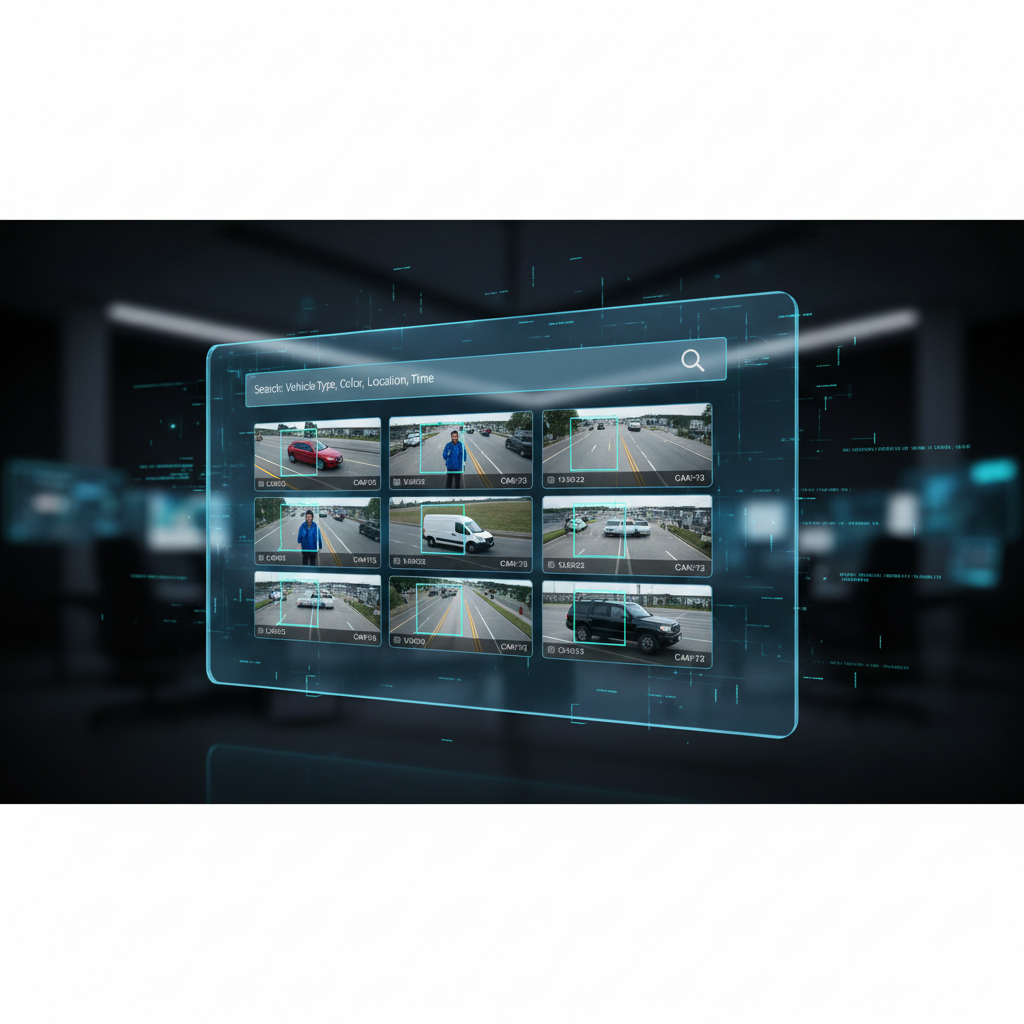
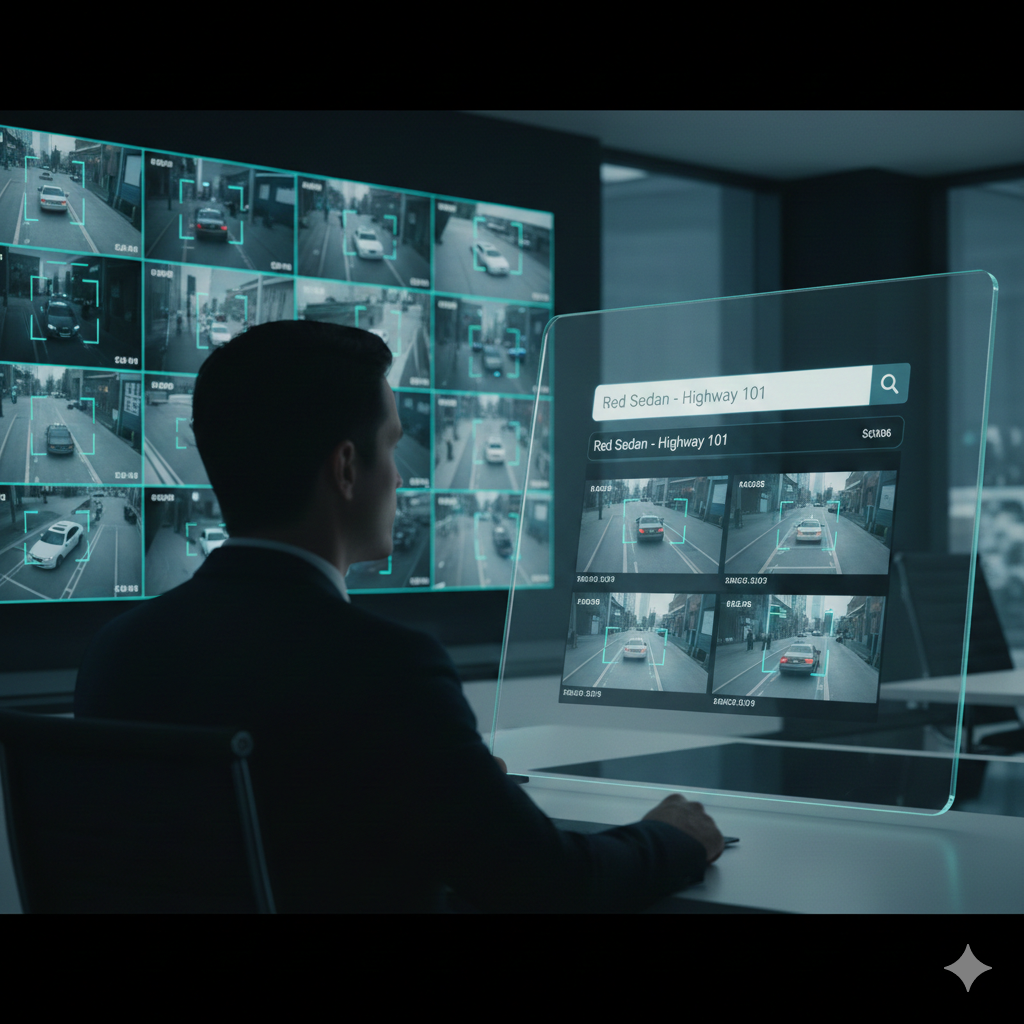
Instead of reviewing hours of footage per camera, a searchable system allows investigators to query for “red car” across the archive.
The result is a structured list of timestamps where a red vehicle appears. Investigators can:
- Confirm when the vehicle first appears at Property A
- Track movement direction across nearby cameras
- Identify the exact highway exit time
- Export relevant timestamps for case documentation
This transforms scattered recordings into a coherent timeline.
4. Example: Searching for a Person or Suspicious Object
In another case, a restricted warehouse reports missing inventory. There is no confirmed time of the incident.
Instead of guessing the window and reviewing entire shifts of footage, investigators can search for:
- Backpack carried through restricted exits
- Cardboard boxes moved outside loading hours
- Hand trucks or trolleys near security doors
- Unusual movement patterns after midnight
The system narrows the review to relevant segments only.
This dramatically reduces review time while increasing detection accuracy.
5. Example: Time-Bound Activity Search
Often investigators know the approximate time window but not the exact activity.
For example: “Show me any vehicle entering between 02:00 and 04:00.”
Instead of manually scrubbing across multiple feeds, searchable indexing allows filtering by:
- Vehicle detection within the time window
- Movement at entrance zones
- Activity clusters in restricted areas
- Person detection in defined regions of interest
This converts passive footage into an active investigative tool.
6. Searching What Was Said (When Audio Exists)
In cases involving bodycam footage, interviews, or microphone-enabled CCTV, speech becomes another searchable dimension.
Investigators can search transcripts for:
- Specific names
- Threatening phrases
- Key statements
- Location references
Instead of replaying entire recordings, teams jump directly to relevant spoken moments.
This adds context and speeds up review in complex cases.
7. What Makes VideoSenseAI Different
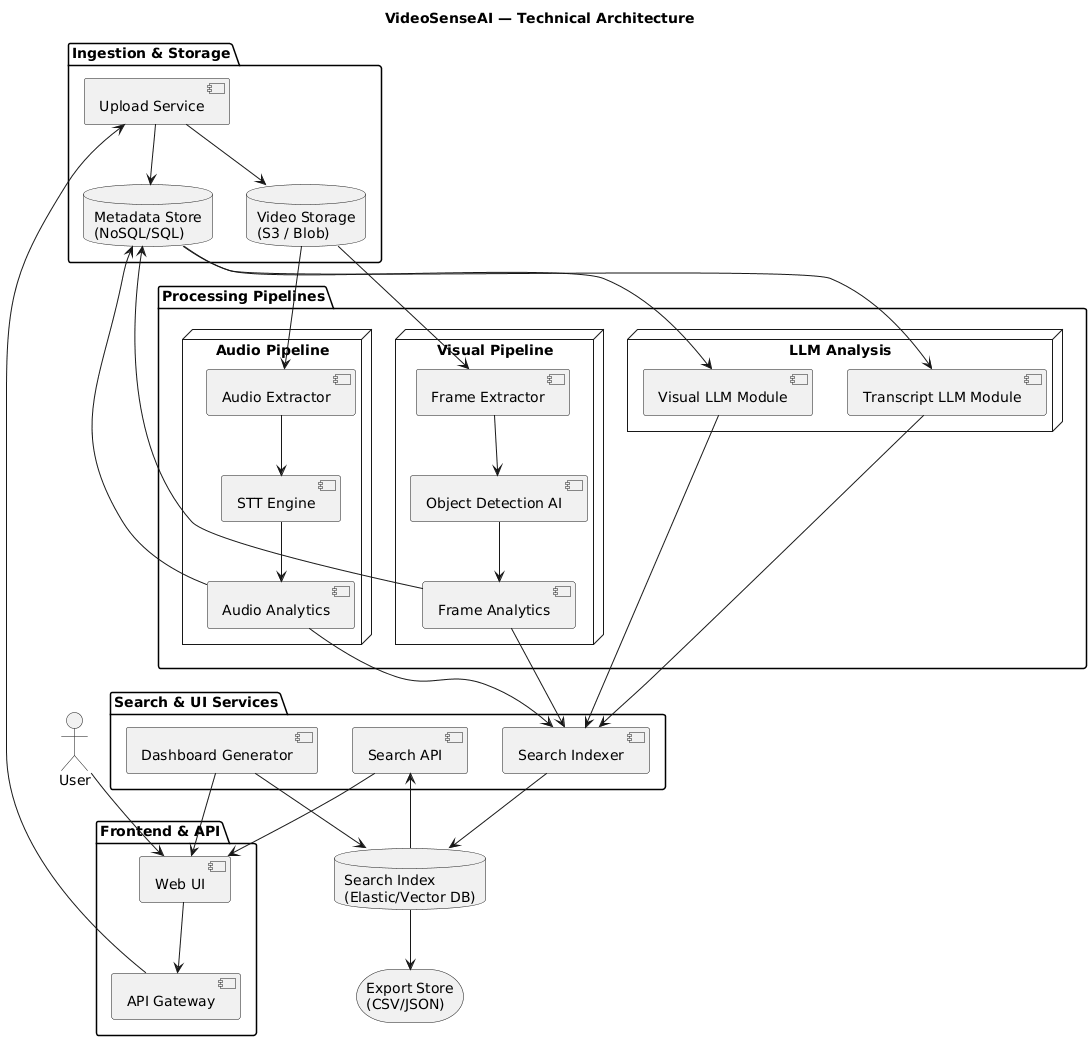
VideoSenseAI approaches recorded footage as structured data rather than passive media.
The workflow is systematic:
- Video is ingested securely
- Visual frames are analyzed for objects and scenes
- Audio is transcribed (when available)
- All detections are linked to precise timestamps
- Results are indexed into a searchable database
The output is no longer just “a file.”
It becomes a queryable dataset with structured evidence markers.
8. Operational Value for Law Enforcement & Security Teams
For investigative teams, this means:
- Faster suspect identification
- Reduced manual review workload
- More consistent evidence documentation
- Clearer timeline reconstruction
- Improved cross-camera tracking
For security agencies, it means faster incident response and stronger preventative analysis.
For private investigation teams, it means better deliverables for clients.
9. From Raw Footage to Searchable Intelligence
Modern investigations increasingly depend on speed and precision.
Searchable video indexing turns long recordings into structured intelligence.
Instead of “watch everything,” teams can:
- Search
- Filter
- Jump to timestamps
- Export structured findings
This changes how recorded video is used operationally.
10. Final Thoughts
Security cameras are everywhere. But without search capabilities, they remain difficult to leverage efficiently.
Searchable video analytics transforms recorded footage into structured, queryable evidence.
For law enforcement, private security, and investigative agencies, this is not a luxury feature.
It’s a workflow upgrade.
To understand the technical foundation behind searchable indexing, read:
How to Turn Video Into Searchable Data
Related Guides
- What Is a Video Search Engine? How AI Turns Video Into Searchable Data
- How to Search Inside Videos for Objects, Words & Events Using AI
These resources explain how AI-powered video indexing works and how long recordings can be converted into structured investigative intelligence.